
Is Knee Replacement in Austin the Right Choice for Your Chronic Pain?
Meta Description: Knee replacement in Austin: Learn about robotic technology, recovery timelines, and expert care from board-certified orthopedic surgeons.

Knee replacement in Austin is a highly successful surgical procedure designed to relieve severe joint pain and restore mobility when conservative treatments fail. By replacing damaged bone with artificial components, patients can return to active lifestyles. According to the NIH, this surgery significantly improves quality of life for those with advanced arthritis, offering a long-term solution for chronic discomfort and functional limitations.
Quick answer for those researching knee replacement options in Austin:
| Question | Short Answer |
|---|---|
| Who needs knee replacement? | People with severe arthritis or joint damage where conservative care has failed |
| What types are available? | Partial (one compartment) or total (all three compartments) |
| What technology is used? | Robotic-assisted surgery, 3D mapping, patient-specific instrumentation |
| How long is recovery? | Most feel better in 6-8 weeks; full recovery takes up to 1 year |
| Is it covered by insurance? | Yes — most major insurers, including Medicare, cover medically necessary cases |
Nearly 800,000 Americans undergo knee replacement surgery every year, and the vast majority report meaningful improvements in pain, mobility, and overall quality of life within weeks of the procedure. Whether you're a retiree who wants to walk the greenbelt again or an active adult trying to get back to cycling or golf, understanding your options is the first step.
I'm Christopher Jimenez, MD, a board-certified hip and knee replacement surgeon, founder of Bone DRs Orthopedic Care, and a recognized Texas Super Doctor who has performed thousands of joint replacement surgeries — including complex revision cases — across Central Texas. As a specialist in Knee Replacement Austin and the surrounding region, I'll walk you through everything you need to make a confident, informed decision about your knee health.
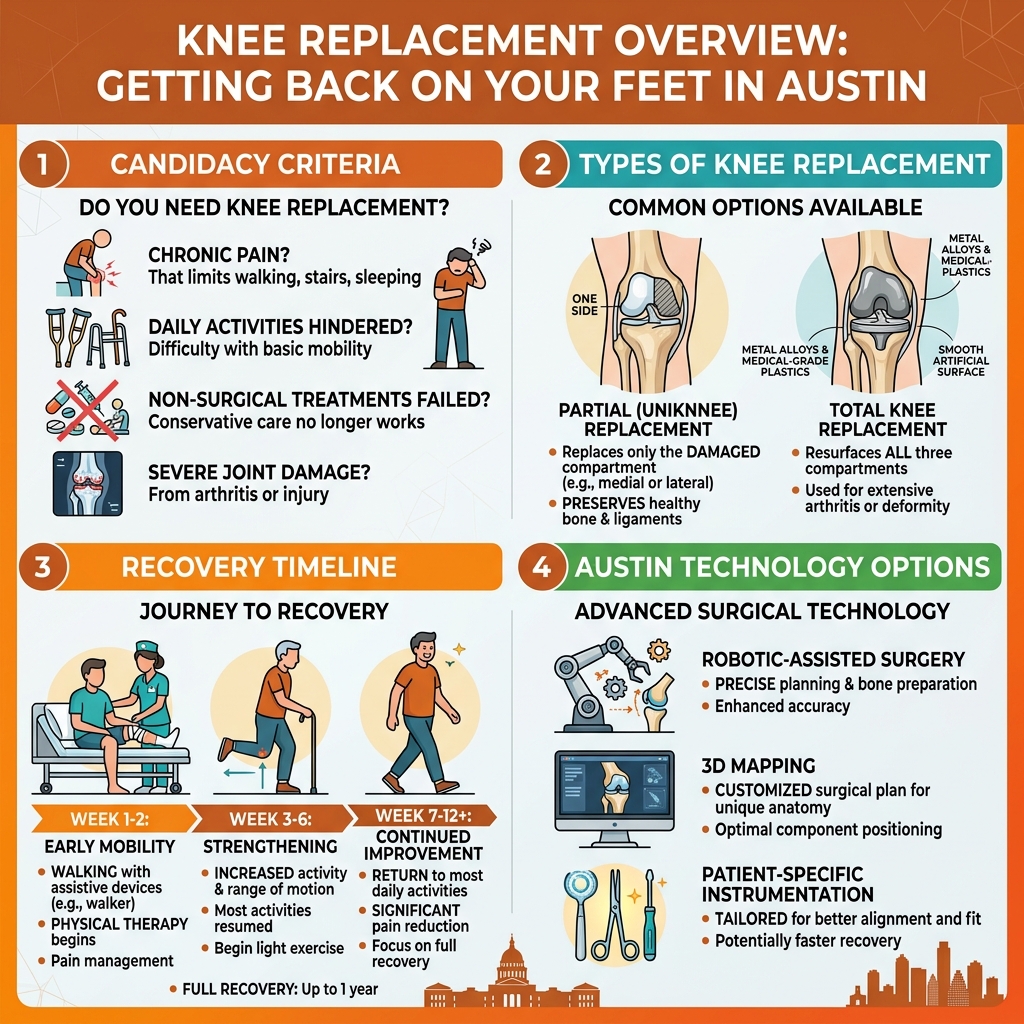
What is Knee Replacement Surgery and When is it Recommended?
Knee replacement surgery is a procedure to resurface a damaged joint with metal and plastic components to eliminate pain and restore function. It is typically recommended when severe arthritis or injury makes daily activities like walking or sleeping difficult despite non-surgical interventions (Mayo Clinic).
Knee replacement surgery, also known as knee arthroplasty, involves removing damaged bone and cartilage from the knee joint and replacing it with artificial components made of metal alloys and medical-grade plastics. We typically recommend this procedure when conservative treatments—such as Knee Pain management, physical therapy, or injections—no longer provide the relief needed to maintain your quality of life.
The primary goal of the surgery is to eliminate the "bone-on-bone" friction that causes Knee Arthritis. By resurfacing the joint, we can restore smooth movement, correct alignment issues, and significantly reduce chronic inflammation.
What are the common causes of chronic knee pain?
Chronic knee pain is frequently caused by degenerative conditions like osteoarthritis or inflammatory diseases such as rheumatoid arthritis.
Chronic knee pain is most often the result of long-term wear and tear or a specific traumatic event that damages the joint's integrity. While every patient we see at BONE DRs is unique, the most frequent culprits include:
- Osteoarthritis: This is the most common form of Knee Osteoarthritis. It is a degenerative "wear-and-tear" process where the protective cartilage that cushions the ends of your bones gradually wears away.
- Rheumatoid Arthritis: An autoimmune condition where the body’s immune system attacks the synovial membrane that surrounds the joint, leading to chronic inflammation and joint destruction.
- Post-Traumatic Arthritis: This can develop years after a serious Knee injury, such as a fracture or a severe ligament tear.
- Avascular Necrosis: A condition where the blood supply to the bone is interrupted, causing the bone tissue to die and the joint to collapse.
- Genetic Predisposition and Obesity: Factors like family history or excess weight can accelerate the breakdown of cartilage over time.
How do I know if I am a candidate for surgery?
You may be a candidate for surgery if you experience severe pain that limits daily activities and has not improved with non-surgical treatments.
Determining if you are ready for a Knee Replacement Austin involves looking at both your physical symptoms and your diagnostic imaging. You might be a candidate if you experience the following:
- Severe Pain During Activity: Pain that limits your ability to walk, climb stairs, or get in and out of chairs.
- Resting Pain: Persistent discomfort that keeps you awake at night or hurts even when you are sitting still.
- Chronic Swelling: Inflammation that does not improve with rest or medications.
- Knee Deformity: A noticeable "bowing" in or out of the knee joint.
- Failure of Other Treatments: You have tried non-surgical alternatives like cortisone shots or physical therapy for several months without success.
Total vs. Partial Knee Replacement Austin: Which Procedure is Right for You?
The choice between total and partial knee replacement depends on whether arthritis affects the entire joint or just one specific compartment. A specialist will use imaging to determine if you can preserve healthy ligaments with a partial procedure or require a full resurfacing.
Not every patient requires a full replacement of the entire joint. Depending on the extent of your arthritis, we may recommend either a total or partial procedure. Your knee is divided into three main compartments: the medial (inside), lateral (outside), and patellofemoral (front/kneecap).
| Feature | Total Knee Replacement | Partial (Unicondylar) Knee Replacement |
|---|---|---|
| Area Replaced | All three compartments | Only one damaged compartment |
| Ligaments | ACL/PCL may be removed/adjusted | ACL and PCL are typically preserved |
| Incision Size | Standard (8–10 inches) | Smaller, minimally invasive |
| Recovery Time | 6–12 weeks for daily activities | 3–6 weeks for daily activities |
| Natural Feel | Very good | Often feels more "natural" |
Benefits of a partial knee replacement
Partial knee replacement offers a quicker recovery and a more natural feel by preserving healthy bone and ligaments.
A Unicondylar Knee Replacement is an excellent option for patients whose arthritis is confined to just one part of the knee. Because we leave the healthy bone and ligaments (like the PCL) untouched, the knee often retains a more natural range of motion.
The benefits of going the partial route include a smaller incision, less blood loss during surgery, and a significantly faster rehabilitation period. Many of our Austin patients find they can return to their favorite activities much sooner than they would with a full replacement.
When is a total knee replacement necessary?
A total knee replacement is necessary when arthritis has progressed to multiple compartments of the joint, requiring a full resurfacing.
If arthritis has spread to two or more compartments of the knee, a Total Knee Replacement is the gold standard. This comprehensive approach ensures that all damaged surfaces are addressed, providing the most reliable long-term solution for severe deformity or advanced joint destruction.
At BONE DRs, we view total replacement as one of our premier Joint Replacement Solutions. It allows us to perfectly realign the limb, which is crucial for patients who have developed significant "knock-knee" or "bow-legged" gaits due to years of cartilage loss.
Advanced Technologies for Knee Replacement Austin Specialists Use
Austin specialists utilize robotic-assisted technology and 3D digital mapping to achieve sub-millimeter precision during implant placement. These advanced tools allow for personalized surgical plans that improve joint alignment and potentially increase the longevity of the replacement.
We are proud to offer the latest surgical innovations to our Central Texas community. Gone are the days of "one-size-fits-all" surgery. Today, we utilize sophisticated tools to ensure every implant is placed with extreme precision.

Advanced robotic technology for Knee Replacement Austin patients
Robotic technology provides surgeons with real-time data and 3D mapping to ensure the most accurate implant placement possible.
One of the biggest breakthroughs in our field is robotic-assisted surgery. This doesn't mean a robot performs the surgery; rather, it acts as a high-tech GPS for the surgeon. We use 3D digital mapping to create a virtual model of your unique anatomy before we even make an incision.
The benefits for you include:
- Millimeter Precision: We can place the implant with incredible accuracy, which improves the "balance" of your knee.
- Improved Longevity: Better alignment means less uneven wear on the polyethylene insert, potentially extending the life of the joint.
- Minimally Invasive Knee Replacement: Robotic assistance allows us to work through smaller incisions, sparing more of your natural muscle and soft tissue.
Handling complex cases and revision surgery
Complex revision surgeries are performed when a previous implant fails due to wear, infection, or injury, requiring specialized techniques.
Sometimes, an older knee replacement can fail due to wear, infection, or a fracture around the implant (periprosthetic fracture). These "revision" cases are highly complex and require a surgeon with specialized training. At BONE DRs, we handle these challenging scenarios using advanced bone grafting techniques and specialized revision components designed to restore stability when the original hardware is no longer sufficient.
What to Expect: Recovery Timeline and Success Rates
Most patients begin walking within 24 hours and return to most daily activities within six to eight weeks following surgery. Success rates are exceptionally high, with the NIH reporting that modern implants often last over 20 years for the vast majority of patients.
Recovery is a marathon, not a sprint, but you'll be hitting milestones faster than you might think. Most of our patients report that they feel significantly better than they did before surgery within just 6 to 8 weeks.
The first 24 to 72 hours post-surgery
The initial days after surgery focus on early mobilization and pain management to ensure a safe transition to home recovery.
Your journey back to mobility begins almost immediately. We typically have our patients standing and taking a few steps within 24 hours of the procedure. This early movement is vital for preventing blood clots and reducing stiffness.
Knowing How to Prepare for a Knee Replacement involves setting up your home for success. We recommend:
- Clearing trip hazards (like rugs or cords).
- Setting up a "recovery station" on the ground floor.
- Arranging for a friend or family member to help with meals and errands for the first week.
Long-term outcomes and implant lifespan
Most modern knee implants are designed to last 20 years or more, providing long-term relief for the majority of patients.
Modern knee replacements are incredibly durable. Research shows that the vast majority of implants last 20 years or more with proper care. To get the most out of your new knee, we encourage maintaining a healthy weight and sticking to low-impact exercises like swimming or cycling.
Mental health is just as important as physical therapy. We often discuss 3 Ways to Mentally Prepare Yourself for Knee Surgery with our patients, as staying positive and patient during the one-year full recovery window is key to a successful outcome.
Non-Surgical Alternatives and Preparing for Your Procedure
Before surgery, doctors often recommend conservative treatments like physical therapy, corticosteroid injections, and weight management to reduce joint stress. If these methods fail to provide relief, "pre-hab" exercises are used to strengthen the knee in preparation for a successful surgical outcome.
We always believe in exhausted conservative care first. Before we discuss surgery, we may explore:
- Injections: Corticosteroids for inflammation or Hyaluronic acid to "lubricate" the joint.
- PRP Therapy: Using your body's own platelets to encourage healing.
- Physical Therapy: Strengthening the muscles around the knee to take the pressure off the joint.
- Weight Management: Losing even five pounds can take 20 to 30 pounds of pressure off your knees during daily activities.
If these options fail, we move toward surgical planning with a focus on "pre-hab"—strengthening your body before surgery to make the post-operative recovery even smoother.
Frequently Asked Questions about Knee Replacement Austin
Understanding the specifics of surgery, from recovery times to potential risks, is essential for making an informed decision about your orthopedic care. Below are answers to the most common questions patients ask when considering knee replacement in the Austin area.
How long does it take to walk after knee replacement?
Most patients are encouraged to stand and walk with the assistance of a walker or crutches within 24 hours of surgery. Early mobilization is critical for preventing complications like blood clots and ensuring a healthy recovery. By the six-week mark, many patients can walk independently for short distances, though full strength continues to build over several months as muscles adapt to the new joint.
What are the risks associated with knee replacement surgery?
While knee replacement is highly safe, potential risks include infection, blood clots, implant loosening, or nerve damage. Surgeons utilize sterile techniques, antibiotics, and blood thinners to minimize these occurrences. Discussing your specific medical history with your specialist helps tailor a plan that mitigates individual risk factors, ensuring the highest level of safety throughout the surgical and recovery process (Mayo Clinic).
Can I return to sports after a knee replacement?
Many patients successfully return to low-impact sports such as golf, swimming, cycling, and doubles tennis after full recovery. High-impact activities like running or jumping are generally discouraged as they can increase wear on the artificial joint. Your surgeon will provide a personalized timeline based on your healing progress and bone quality, helping you safely return to the activities you enjoy most.
How much does knee replacement cost in Austin?
The cost of knee replacement varies based on insurance coverage, the specific facility used, and whether the procedure is inpatient or outpatient. Most major insurance providers, including Medicare, cover the procedure when it is deemed medically necessary. It is recommended to obtain a personalized cost estimate and verify coverage with your provider during the consultation phase to understand your specific financial responsibilities.
Conclusion
Knee replacement surgery in Austin combines expert surgical skill with advanced technology to help patients overcome debilitating joint pain. By choosing a qualified specialist, you can look forward to a successful recovery and a return to an active, independent lifestyle.
Choosing to undergo knee replacement is a significant step toward a pain-free life. By leveraging the expertise of local specialists and the latest surgical innovations, patients in the Austin area can expect high success rates and a return to the activities they love. Whether you want to hike the trails at Lady Bird Lake or simply play with your grandkids without wincing, we are here to help.
BONE DRs Orthopedic Care provides the personalized, multidisciplinary support needed to guide you through every stage of this journey, from initial diagnosis to final rehabilitation. Our board-certified specialists serve Austin, San Marcos, Bastrop, and North Austin with a commitment to getting you back on your feet.
If you have any concerns about your joints, contact us and we can help determine a treatment that works for you.